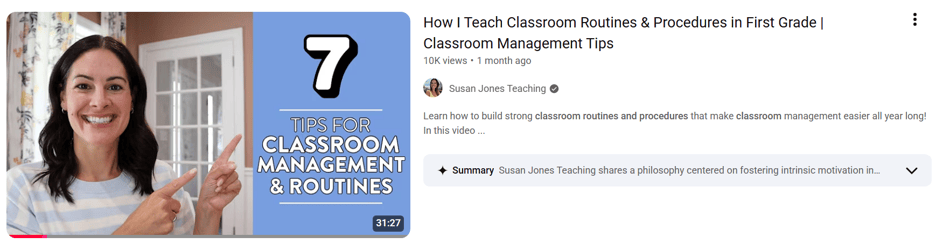
Why Do I Trust This Teacher?
When I look online for ideas about teaching, I make judgments about credibility surprisingly quickly. Before I have had much opportunity to evaluate someone’s advice, I am already deciding whether that person seems worth listening to. John Silvestro’s concept of digital ethos provides an interesting way of thinking about how those judgments are formed.
Silvestro argues that ethos online does not belong entirely to the person producing the content. Instead, credibility develops through relationships among the creator, audiences, platforms, other circulating texts, and the norms of the particular digital space. Audiences participate in this process when they comment, like, share, follow, or choose not to circulate something. In other words, digital credibility is something people construct together rather than something a creator simply possesses.
I thought about this while watching Susan Jones Teaching’s recent YouTube video, “How I Teach Classroom Routines & Procedures in First Grade | Classroom Management Tips.” Jones is a first-grade teacher who creates videos primarily for K–2 educators. In this video, she discusses classroom-management practices she has developed through approximately fifteen years of teaching.
Several things make me willing to listen before I have evaluated much of her advice. Her channel contains an extensive catalog of teaching videos. The title identifies her as a first-grade teacher. She speaks from an actual classroom, and her presentation is organized and professional. Together, those signals position her as someone with relevant experience rather than simply someone offering opinions about teaching.
But Silvestro’s framework draws attention to another layer. Jones’s credibility is also being constructed around her. Her channel has more than 200,000 subscribers, and the video had received thousands of views when I encountered it. YouTube makes these measures visible alongside the content. Jones also invites viewers to like, subscribe, comment, ask questions, and share their own classroom-management ideas. Those interactions do more than measure an audience. They become part of the digital environment through which future viewers encounter and evaluate her.
This raises an important distinction for me: what gets me to listen isn’t necessarily the same thing as what gives me reason to trust what I’m hearing.
For example, Jones’s subscriber count would not make me accept teaching advice that did not make sense based on my own experience. If I encountered two conflicting approaches that both seemed reasonable, visible evidence that many other teachers regularly engage with one creator might influence which source I investigated further. But popularity alone could not tell me whether a strategy would work with the students in front of me.
That is where Silvestro’s digital ethos intersects with something important about professional judgment. Online credibility can help teachers decide which voices may be worth considering, but credibility cannot make the instructional decision for us. Interestingly, Jones often presents her own advice this way. She acknowledges that classroom management took years for her to develop, that teachers differ, and that some practices she previously used have changed. Her credibility therefore comes partly from presenting teaching knowledge as situated and revisable rather than universally applicable.
Carroll’s discussion of digital editing also helps explain why presentation matters here. Digital communication involves decisions about audience, purpose, organization, medium, accessibility, and presentation. Jones’s classroom setting, clear organization, conversational voice, and focused video title all make her expertise easier for an audience of teachers to recognize and use.
For teachers searching online, then, perhaps evaluating credibility requires two separate questions: What made me decide this person was worth listening to? And what evidence would tell me whether this advice is worth using in my classroom?


Leave a Reply